Case Solving for beginners

It’s better to start with why you should learn case solving. From my experience, 3 reasons:

(1) Keep up with the business world, gain practical knowledge and skills through up-to-date cases. It’s extremely meaningful to me, as university classes are mostly theory-based with out-of-date case studies.

(2) Expand relationship network. Join case competitions, make new friends, and network with MNCs’ employees.

(3) Get future job opportunities. After joining business case competitions, you will have stories to tell in the job interview & you can get the position by employee reference after the case competitions.

And now, how to start?

(1) Read fundamental books. You can get the list from internet, but here is my recommendation: [Huy Luu] Case Books

(2) Start the habit of reading news every day. Below are some of the sources that I am following now, I use Feedly.com, a website that allows you to include all the news sources in one place. My mentor Nam Le introduced this website to me. Besides, I subscribe to email newsletter from Finimize and PitchBook.
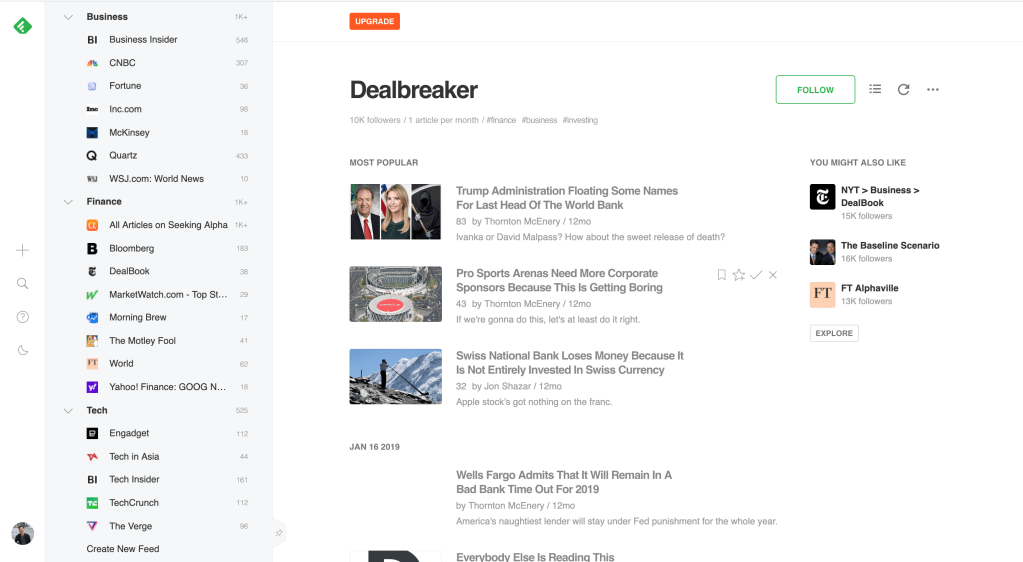
(3 – most important) Find a learning partner. He/she will be the one who reads & discusses books/news with you. Then maybe, set up a case team to join business case competitions/recruitment programs together.

After these steps, you can jump into some case competitions to apply what you have read, or just follow those habits to expand your knowledge

Jan 15

 03 most interesting news today

  1. #banking. Morningbrew

US banks are up. Trade wars trimmed the growth of commercial and industrial loans as business paused new investment. They shifted the focus to other less volatile business such as wealth management.

  1. #ridehailing. Quartz

Uber made some changes to its business, no more upfront pricing for non-Pool and the return of surge multiplier for long trips.

  1. #banking. SeekingAlpha

JP Morgan delivered the best performance among its peers, with growth in consumer cards, IB and markets.

Summary of my favorite topic: Visa acquired Plaid

Source 1: PitchBook

Source 2: Forbes

Source 3: Businesswire

Visa has made a big move, acquiring Plaid for ~$5.5B (35x revenue multiple valuation), making this the biggest M&A in FinTech of all time. The acquisition is expected to fuel the growth trajectory of Visa (the provider of network) in 2 ways: (1) Expanding customer base and (2) Making it easier to connect all the financial networks within Visa.

Buying Plaid, Visa can get access to the ballooning base of Plaid customers, which is estimated to be approximately 200M, CAGR 100% since 2015. It’s a chance to sell additional financial services to these customers.

Also, Plaid with it software technology will help Visa connect all of its global unparalleled financial technology. Plaid’s software link a a number of personal finance apps with banks and other platforms. This technology is the one Visa needs to go global with its services, to the goal of not only being a payment method, but enabling movement of fund in any settings globally

Jan 14

 03 most interesting news today

  1. #retail. Fortune

Walmart on online retailing. Walmart accounts for 56% grocery revenue in the US, which creates a sustainable number of visiting customers to their website every day. Instead of shifting the focus to other non-grocery merchandise, the CEO said that they will look at the overall growth of digital business as a whole.

  1. #startupvaluation. Thesaigontimes

A lesson from the failure in WeWork’ valuation, which led to their IPO scandal. Analyst used Community Adjusted EBITDA (a non GAAP number) to mislead investors. 

  1. #airline. Morningbrew

Tasks for the new CEO of Boeing. #1 Get Boeing flying again, as it has already pulled many US suppliers down. #2 Restore trust, Boeing is having “new” culture of prioritizing speed over safety.

Summary of my favorite topic: Meituan Dianping’s Path towards Profitability

Meituan Dianping (MD), Super App in China, just became profitable last quarter, after 6 years of cash burning in a crowded market. This article illustrates what it is and why it can make profit in a notorious loss-making food delivery service.

MD offers users a wide range of services, ranging from food delivery, to group coupon, household cleaning and hotel booking. Normally MD users first came to the app for scouting restaurants or food delivery, but continue with more than 5 services after that. Its users stickiness and retention rate is the highest among other players.

MD food delivery came profitable from economy of scale and increasing revenue from advertising. MD targeted 2-tier cities first, instead of 1-tier to avoid high competition. When the number of order increases, MD groups different orders in one delivery and optimizes its advanced routing algorithms to reduce cost per order. Also, when the app dominates the market, the increasing number of revenue and orders incentivizes SMEs in China to pour money into the app for advertising

Jan 13

 03 most interesting news today

  1. #startup. Pitchbook

SoftBank’s new severity. In one week, four big startups in SoftBank’s portfolio decided to pare back their workforce. All these layoffs were to presage complete collapses for the companies involved.

  1. #F&B

Starbuck failed to crack Vietnam coffee market. 3 reasons: (1) Highly fragmented market with fierce competition, (2) Difference in types of coffee beans and (3) Various & fast-changing local tastes

  1. #superapp. Techinasia

Grab is betting on food delivery and financial services as the next big engines of growth, not ride-hailing anymore. 

Summary of my favorite topic: Vietnam stocks fail to reap spoils of US-China trade war

Vietnam is expected to be the winner of the trade world, but the unstable market reflects profitless prosperity. Vietnam stock market is dominated by banks (34.%) and one real-estate developer (VinGroup JSC – 16.1%).  These two industries bear so many risks for investors.

With average return on equity at 15%, banks in Vietnam are enviable bunch by any standard. However, while emerging markets staged a Santa rally at the end of 2019, Vietnamese stocks headed the other way. Besides, bank loans have already exceeded the country’s GDP level and roughly half of local banks are unable to meet the minimum 8% capital adequacy ratio.

While Vingroup has edged into auto and smartphone manufacturing, cash-cow business remains property. It is becoming problematic when land has become scarce — it’s difficult to find large parcels in the megacities of Hanoi and Ho Chi Minh City. As such, the government has slowed approving new projects, sapping growth potential for developers.