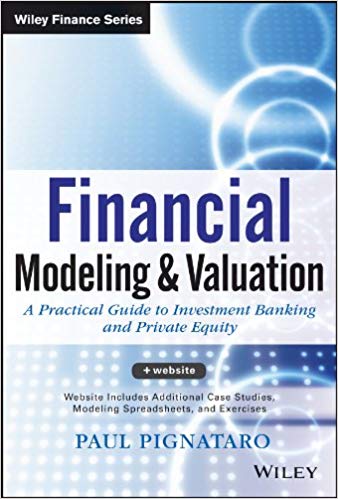
Anyone can learn to do financial model with this book. It is built around a full-length case study of Wal-Mart, with an attached excel file for you to practice step-by-step when you walkthrough the book.
These are three essentials piece of knowledge after all:
- The process building a financial model
Income Statement -> Cash Flow Statement -> Depreciation Schedule -> Working Capital -> Balance Sheet -> Debt Schedule -> 3 Valuation techniques
This book recommend modeling Cash Flow first, then use it to drive the Balance Sheet. It is a more logical approach, and has been proven to be less prone to errors than using Balance Sheet to drive Cash Flow.
- Three core method of valuation
(1) Discounted cash flow analysis
The discounted cash flow (DCF) analysis is known as the most “technical” of the three major methods, as it is based on the company’s cash flows. The discounted cash flow takes the company’s projected unlevered free cash flow (UFCF) and discounts it back to present value (PV)
(2) Comparable company analysis
The comparable company analysis compares our company with companies that are similar in size, product, and geography. The comparable company analysis utilizes multiples as a measure of comparison.
(3) Precendent company analysis
The precedent transactions analysis assesses relative value by looking at multiples of historical transactions. The value of our company is relative to the price others have paid for similar companies
- Seven methods of projection
(1) Conservative (the minimum of the past three years)
(2) Aggressive (the maximum of the past three years)
(3 Average (the average of the past three years)
(4) Last year (recent performance)
(5) Repeat the cycle
(6) Year-over-year growth
(7) Project out as a percentage of financial statements

 Huy Luu's business blog