Oct 7: Shopee, Flipkart, Google and Apple

  1. #Ecommerce Shopee strikes 5-year partnership with Visa to help SMEs digitalise (marketing-interactive.com)

Shopee and Visa has tied up a 5-year regional partnership.

  • Shopee users could enjoy additional promotions and rewards by using Visa
  • Visa could reach to Shopee’s extensive customer base to expand its presence to SEA online businesses and customers

2. #Ecommerce Flipkart buys parent Walmart’s Indian wholesale business (Reuters)

In July, Flipkart has bought its parent (Walmart) cash and carry operator: Best Price. This is one of its steps to empower the wholesale sector in India, which links directly to mom-and-pop stores

3. #tech China’s Closed. So Google Invests $10 Billion In India, Following Facebook, Amazon, Apple (Forbes)

Google (or its parent company, Alphabet) investing $10 billion in 4 areas:

  1. Localization: “enabling affordable access and information for every Indian in their own language.” (India has no fewer than 23 constitutionally recognized languages.)
  2. Google and Alphabet products and services specifically built for India
  3. Digital transformation: helping businesses in India go digital first
  4. Social good: “leveraging technology and AI for social good, in areas like health, education, and agriculture

India is becoming a more fertile land for tech giants than China:

  • India’s population is 1.36B, catching up with China’s 1.4B
  • India is relatively open for business, under certain conditions. China has long banned foreign companies that could compete with its domestic companies. The country is a totalitarian regime that oppresses many minorities and uses sophisticated technology to spy on its people — and, of course, censors many topics internally

4. #tech buys start-up to turn iPhones into payment terminals (Bloomberg)

Apple has acquired Mobeewave Inc., a start-up with technology that could transform iPhones into mobile payment terminals. Mobeewave’s technology let’s shopeers tap their credit card or smartphone on another phone to process payment
Sept 16, 2020: Disney, Google and Lloyd’s of London

  1. #entertainment  Coronavirus slammed Disney’s core business (MarketWatch)

What’s up?

Disney, the Magic Kingdom’s once sorcerous profitability, endured a greater existential financial crisis in the age of COVID-19.

Zooming out

The Mouse House faces adversity in its three core business units: 

  • The theme park business experienced the most appreciable financial impact when the signature amusement parks in California and Florida were shut down.
  • All live-action film production stopped in the company’s movie division. The release of the big-budget remake: “Mulan” was delayed indefinitely as most theaters remained dark across the country.
  • The media network, which generated $24.8 billions dollars in revenue last year is equally vexing. The status of Major League Baseball’s truncated 60-game season teeters on collapse with the outbreak of COVID-19 among players and staff of the Miami Marlins.

Besides, it is unfortunate that, even when the pandemic is over, the damage of the super-expensive acquisition of 21st Century Fox is likely to saddle Disney with far lower returns.

  1. #tech Google: The next big FinTech vendor (Forbes)

What’s up?

US banks is likely to partner with Google to monetize their customer relationships for two reasons:

  • Customer prowess: Currently all banks do not have their own in-house infrastructure but rely on vendors like FIS and Fiserv. However, customers do not see these two from Adam. Therefore, Google’s name recognition is seen as a way to drive utilization of checking account and debit cards.
  • Technology and Analytics expertise: While there are so many talks on chatbot and machine learning, only a few banks actually deployed them. Then who would be better to turn to than the leader in the space?
  1. #insurance The most annoying sound in the world from Lloyd’s of London (Finimize)

What’s up

Lloyd’s of London made a loss of $530M loss before tax in the first 6 months, and it is expected to fork out another $3 billions throughout the rest of 2020. The combined ratio of the company is 110% compared to 98.8% the same time last year.

Why should I care?

  • The insurance industry is not doing good. Lloyd’s of London is seen as the barometer of the industry because of its broad span. The company provides insurance for people and businesses, including other insurance companies via “reinsurance”.
  • It is getting worse and worse. UK financial authorities are currently contesting insurers’ avowed lack of liability for certain pandemic-related claims which typically apply only in cases of physical damage. The outcome could lead to higher costs for insurers everywhere.

April 16: COVID in Vietnam, SoftBank and US MegaBanks

  1. (Vietnam economics) CORONA Watch by Mr. Linh Nguyen (R&I Director of SSI)

It’s the first time I put a link to a Vietnamese analysis. This post does provide me with some insights that I do not know about the country economy, and with really thought-provoking points.

Main points

  • Vietnam is likely to experience a negative economic growth in Q2, 2020 because of the decline of 6 key industries of our GDP: manufacturing (19%), agriculture (10%), retail (9.8%), construction (6.5%), finance banking (5.9%) and mining (5.6%).
  • Some advantages of this period compared with 2009-2012: more cash, low inflation, the growth drivers shifts to FDI and private sectors.
  • Some recommendations: (1) boost public investment, esp in Southern, (2) restructure banking system and (3) support the private sector.
  1. (Tech) An interview with Softbank’s powerful Son amid COVID 19 (forbes)

What’s up?

While Softbank is expected to lost $17B in the outbreak, his founder is still positive about its future with new directions.

Zooming out

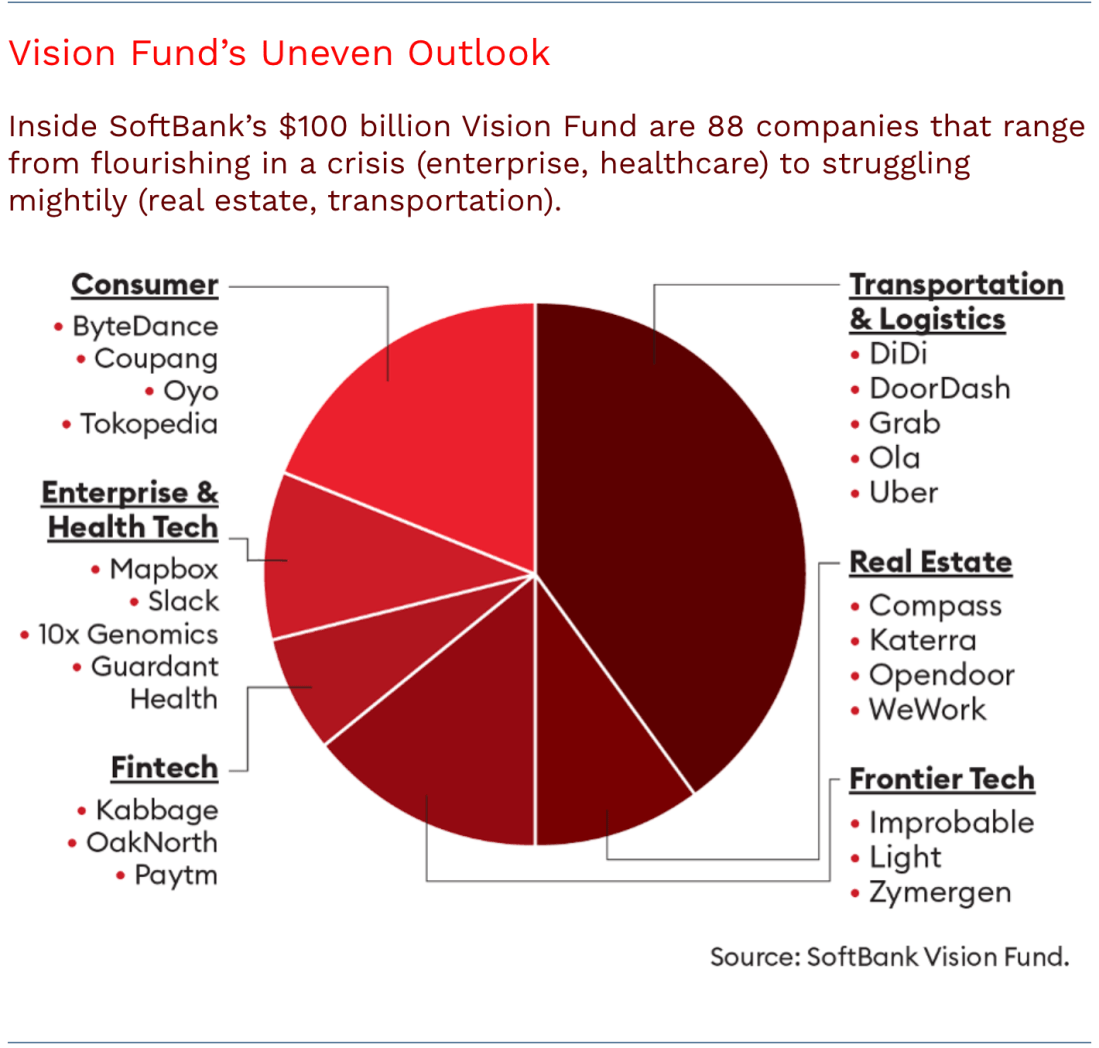
  • Tough love began: pulled back $3B from Wework, withheld cash installment from Brandless, let some of its portfolio lay off and break out. Approximately 15 of them.
  • Profitability-driven: now Son is asking start-ups in SB’s portfolio to shift their focus to profitability to prevent the situations like WeWork debacle.

Son believes the some big, dizzying bets in Alibaba, Slack and Uber will save the whole. The fund can return $150B, which means it can still payback its limited partners their principal with 7% annual returns, and still eke out a profit.

  1. (banking) The scariest number from this week’s megabank earning reports (The Motley Fool)

What’s going on?

While their results come with prediction, one single metric could lead to incredibly painful periods head: loan loss reserves: $22B, 8.5x last year number.

Zooming out

Massive wave of defaults in the months ahead as tens of thousands American lost their job, reduce income then fall behind deb payments.

The government jumped in, but cannot help much: $2.2 trillions for individuals and business and $4 trillions from FED may only support the most affected sectors like airlines, F&B, and not all businesses can apply for the package. This author did bring a distinctive perspective: Some companies deserves to fail

However, the situation is still better than 2008-2010 as the banking system are now protected with higher standards and higher requirements of reserved capital to deal with shocks like this.

Mar 17: The Auto Industry! What did Tesla do with it?

*Note: Content from other sources is summarized in normal format, my original content is in italic

Source: Mostly from Quartz and Finimize, the best newsletters on business updates and analysis/strategy right now to me

Biggest manufacturers in the world

  • By countries: China (over twice as many as the second player) -> America, Japan -> Germany and India. China’ve just accelerated since mids 2000s with cheap labor and excellent capabilities.
  • By companies: Toyota, Volkswagen -> Huyndai -> General Motors and Ford. The funny thing is, if we talk about valuation, Tesla is the world’s second biggest, without any reported annual profit.

How The Market’s changing

  • Shifting geography of car sales: Emerging markets (like China) are getting more cars, and also more “after sales” products. 
  • Electric cars: fossil fuel scarcity and climate change is moving the world towards EVs.
  • Autonomous vehicles: It is expected that 40% of European personal mileage could be autonomous by 2030 (PwC). This also brings a seismic impact on the way we move around: “shared autonomous driving”

The Challenges Ahead

  • Advanced technology doesn’t come cheap.
  • The US-China trade war is driving up price on steel and car parts 
  • A recession is coming that makes consumers stick with their existing vehicle. The probability is high when Covid-19 epidemic is expected to cost global economy $2.7 Trillion (Bloomberg)

What about Tesla?

  • It is now the world’s second most valuable car manufacturer (BI)
  • It reached 1 million vehicles last March 09 (Electrek) and became the largest EV carmakers in the world. The follower: BYD can deliver nearly the same capacity, but with plug-in hybrid models.
  • 2019 is a turning point for the company as it is entering its mass-production phase. Tesla is in a Goldilocks situation: when its luxury rivals are still too expensive, while the entry-level competitors aren’t attractive enough (Quartz)

I think the reason why Tesla can reach such a high valuation is its distinctive value proposition. The traditional auto industry is saturated. In every price range, different brands could bring the same specifications and people just look at the “logo” to make a decision. Tesla is different, the company also works towards efficiency and environmental-friendly goals. 

Mar 13: Amazon & Alipay

*Note: Content from other sources is summarized in normal format, my original content is in italic

  1. #retail Amazon creates business arm selling automated checkout to retailers (internetretailing.net)

What’s up

Amazon decided to sell the cash-less technology behind Amazon Go to other retailers

Why should I know?

  • For retailers: They will have more customers. Consumers tend to buy more in stores with high technology and less friction.
  • For Amazon: customer data, holy crap!!! The online retail juggernaut can collect more shopping data without spending a bunch in brick-and-mortar stores. Also, this is the first step of Amazon in integrating technology in traditional retailers, more to come.

I guess it will take at least some years for the technology to spread over America . Currently it can only be integrated in small-sized stores, then the labor-saved cost of using this technology is still far from the upfront capital expenditure for the technology itself.

  1. #retail How Amazon Delivers On One-Day Shipping (Youtube)

Let’s see how Amazon curbs the delivery burden in each step to customer

  • Before you order: It analyses data to deliver products, which you are likely-to-buy, to the warehouses near your house before you buy.
  • In the fulfillment center: Robots replace humans. Also, employees are paid better than normal to do more. Amazon even provides employees with wearables to track their productivity
  • Long-distance delivery: Amazon increasingly operates on its own with leased cargo fleets, semi-trucks and Amazon boats.
  • Last-mile delivery (highest cost): (1) Adopt technology as robots or drones and (2) Run its own Amazon-flex team with the cost-optimized model like Uber and Grab.
  1. #tech ALIPAY TO HELP 40 MILLION CHINESE SERVICE PROVIDERS DIGITIZE OPERATIONS (aliza.com)

What’s up

Alipay, the mobile payment platform operated by Ant Financial, this week laid out plans to open up its platform and offer upgraded tools and features to help 40 million service providers digitize their businesses over the next three years.

Why should I know?

  • A smart move of Alipay as the service sector accounts for ~60% China GDP growth and it is still in nascent stage of digital transformation, which means it has a huge untapped potential.
  • Alipay’s development roadmap is typical for any mobile-payment players to follow. They went from an e-wallet, to wealth management , financial services and now even digitization services. Each step builds foundation for the next one.

Mar 11 & 12: OYO – another WeWork deal for SoftBank?

*Note: Content from other sources is written in normal, my original content is in italic

Today I will write about OYO: What it is, its business model, and my doubts on its future.

Oyo – What is it? (source: quartz)

Oyo Rooms is an Indian hotel chain. It is the world’s third-largest and fastest-growing hospitality chain of leased and franchised hotels, homes and living spaces. (Read more on Wikipedia)

On Step 25, 2018 OYO Rooms had secured $1 billion in fresh funding. The capital infusion was led by existing investors SoftBank Vision Fund, Sequoia Capital, and Lightspeed Venture Partners. The funding makes OYO India’s latest unicorn, and the second-most valuable after One97 Communications.

Oyo Business model  (source: bstrategyhub.com)

Oyo started as a hotel aggregator and used to lease some rooms and sell them under its brand name. However, it changed its business model from the aggregator to the franchise model. It involved partnering with hotels, asking them to operate as a franchise, and selling their rooms to customers at competitive prices.

Oyo does not own hotel properties that are listed on their website. Oyo renovates the hotels according to its checklist of standard services, and makes the hotel property a part of its “standardized budget hotel chain” with Oyo’s branding. Their focus is user experience (achieved by standardized services) rather than availability and price as other hotel chains. 

Customer segments: focus on backpack and leisure travellers. Customers get access to Oyo via its website or mobile app.

Product portfolio: (1) Oyo Townhouse for millenials, (2) Oyo Flagship – premium, (3) Oyo B Direct serves business class, (4) Weddingz.in: wedding place lease, (5) Oyo Wizard: a subscription service,…

How does Oyo make money?

  • Commissions: 22% of commissions every month from hotels owners
  • Membership fees from Oyo Wizard, a subscription model where wizard members can get available exclusive discounts, offers, deals, and cash back advantages
  • Advertising, sponsorship and partnership
  • Consulting Services: business consulting and data analysis services for other hotel chains

Why I think Oyo’s future is gloomy

  1. The unclear value proposition

The core USP “budget with high-quality” is not sustainable. Both the aggregator and franchising model are hard to control when it expands to other market. Also, the exit barrier is low. It’s likely hotel owners or Oyo employees exit the company after a time, and work with other platforms with lower commission fee . Besides, it’s impossible if Oyo wants to be a digital/analytics company as their main assets/core advantages is a relationship network with hotel owners, not technology

  1. Market expansion is on the brink of collapse

Oyo easily succeeded in India, where most people are in the middle class, and technology/internet is on its growth peak. The story is different in other countries, where the internet competition is higher and people are less price-sensitive. Let’s take China for example. It’s reported that Meitu and Ctrip (the biggest OTAs in China) refused to work with Oyo as they offer the same type of services as the Indian company. Also, there were a large number of poor service reports in other markets (quartz).

Mar 08- 10: Amazon – A deeper look into the Eccomerce colossus

I have spent over 3 days to read some analysis on Amazon in Quart and Finimize, the best newsletters on business updates and strategy right now to me.

First notice, I only include some “new” insights, while neglecting basic information of this company. If you have never read on Amazon, I recommend reading these ones first: Prime story (Vox) and Amazon overview (Quartz). It takes only 20-30m.

The ingredients of Amazon’s retail dominance

  • Convenience: 1-click ordering, fast and free shipping, and Prime (Amazon’s signature)
  • Price: Amazon can bring the best price as it’s an efficient cost structure. It comprises: (1) A large partner network from logistics, retailers and technology companies (2) Investment in key activities (FBA, promotions,..) (3) Access to key technology to optimize operations (ex: Robots in warehouses)

What does Amazon take from business owners?

I usually think that the price for a brand to operate successfully in Amazon is cheap, but it’s actually not, the cost may even account for ~50% of their revenue: 

  1. Commission on sales – for Amazon
  2. Shipping – the highest cost, which is included in FBA. Every brands chooses FBA to bring the best customer experience, then it’s like a must-have item when a brands registers in Amazon
  3. Advertising – another “must-have” cost
  4. Storage

Amazon’s bets on brick-and-mortar stores

There are 2 reasons why Amazon decided to get physical

  • Stores are still where most shopping happen (89% sales in the US)
  • Stores are places where Amazon can implement its experiments. When Amazon gets bigger, its experiments need to be put on bigger scale and a larger number of customers.

Amazon current physical-store footprint in the US

  • 487 Whole Foods stores: Amazon acquired this chain last year to access organic products’ wealthy customer base, which is also the target of Amazon Prime
  • 23 GO storer: small-sized ones where Amazon experiment the non-cashier services
  • 21 book stores: the entry product that it uses to lure customers
  • 9 4*-stores: where Amazon sell highest-rated products in its marketplace

There are rumors that the company will open its first grocery stores at the end of 2020

The failed global ambitions

Let’s look at some of other markets that Amazon focuses outside US

  • India (the main one): While sales is yet to contribute much to company’s overall performance, Amazon has to deal with the harsh competition from Walmart and concerns from antitrust regulators
  • China: Amazon finally gave in the business here in 2019
  • Brazil: cannot compete with entrenched e-commerce leaders
  • Europe: overall Amazon is thriving here. However, it cannot compete in the most lucrative category: apparel and also there is many antitrust concerns over countries
  • Japan & Mexico: managed to gain a foothold, despite the competition from rivals such as Japan’s Rakuten and MercadoLibre again in Mexico

In recent years, it has also started selling in places such as Australia, Turkey, the United Arab Emirates, and Singapore

The impact of warehouse automation

Amazon’s warehouse operation is an art. Read it here (Quartz) . Yeh then this art yields a huge impact on both customers and Amazons

  • To customer: Reduce delivery time. By using robots, the time between orders received and orders shipped reduced from 75m to just 15h
  • To Amazon: lower cost – Robots work faster and more accurately than humans. Also, the factory aisles no longer need to be wide enough for people (attached p

Mar 07: Oil and Gas Industry – Market Snapshot

Oil and Gas Industry

Today I will summarize all the analysis on the oil and gas industry that I read in Finimize Premium. Finimize, along with Quartz,  are the best newsletter on business updates and analysis/strategy right now to me

Overall, The industry has experienced some of the biggest changes in its entire history over the past decade: “peak oil demand” due to 2 recent trends

  • The shale revolution in the US unlock a massive amount of oil that experts previously thought was too expensive to extract
  • The cost of renewable energy plummeted thanks to greater innovation and scale, helping reduce the world’s reliance on traditional fossil fuels to meet its energy needs

The four key parts of energy value chain

  • Upstream: Companies look for reserves and extracts oil and gas once they’ve found. Key factors determining profits: production volume, prices and operational efficiency
  • Downstream: Companies convert those above products into usable products such as fuel, plastic and petrochemicals. Key factors determining profits: market output and input price, utilization rate
  • Midstream: The ones who link the two Upstream and Downstream together, storing and transporting oil and gas across networks of pipelines, railroads, trucks,.. It also transports finished products to end users. Key factors determining profits: volume
  • Oilfield services: Companies provide equipment and services that help upstream companies explore for and extract oil and gas

The shift in Supplies

From 1859 to present, the most prominent and conventional way to drill oil is using a steam engine to drill into an oil reservoir and pumping its contents up to the surface. This method is divided into 2 types

  • Onshore: production on land
  • Offshore: production beneath the seabed

It’s simple, then it’s the cheapest way  to produce oil. However, there is a new way emerging and changing the supply landscape: natural gas. It is produced virtually  the same way as oil, but less environmental-damage. An example of its is shale production in the US

The changes in demand

Overall, it’s likely that it will decline deeply in the future. 

  • Oil: Two most important outputs of refined oil are gasoline and diesel, which are principally transport fuels, then transportation is the single most important factor in the demand equation (>50% world demand). It is facing an emerging threat from EVs
  • Gas: The single largest use of natural gas is electricity generation and heating in residential and commercial buildings (>⅔ world demand). The use is mainly driven  by the power sector with a fast transitioning towards renewables. 

The factors that influence the price

  • Long-term: it’s the sorts of supply & demand as oil and gas are commodities
  • Short-term: (1) Seasonal trends; (2) Inventory; (3) Speculators and (4)Geopolitics

Mar 06: MUFG & Grab, Luckin, Microsoft & Slack

  1. #tech MUFG pumped $700M investment into Grab (Dealstreetasia)

What’s up?

Mitsubishi UFJ Financial Group Inc. is investing more than $700 million in Southeast Asian ride-hailing giant Grab. It’s a three-way deal in which everyone gets what they currently lack.

Why should I know?

  • For Grab: 1) Pick up an only-online banking license in Singapore which requires $1.15B and (2) Get access to the wide regional network (Indonesia, Thailand, Philippines)  of the deep-pocketed MUFG
  • For MUFG: Get out of the local pressure as negative interest rate bites at home. Backing Grabs will help MUFG to market a wide range of its financial services from loans to insurance to Grab’s users
  • For Softbank: A sigh of relief all around as its core start-up in Vision Fund portfolio will not need cash-feeding any more. That’s one less mouth to feed in the wake of disastrous bets like WeWork
  1. #fooddelivery Analysis of Luckin’s advantages and disadvantages in the CoVid-19 epidemic (Dealstreetasia)

What’s up?

A writer in Dealstreetasia pointed out the position of Luckin in the severe acute respiratory syndrome outbreak

Zooming out

  • Advantages: (1) The delivery model that proves more resilient than other competitors like Starbucks- who positions itself as selling not only coffee, but experience. (2) The strong financial position after additional share sales and convertible bond offering.
  • Disadvantages: (1) Travel restriction; (2) Manufacturer halts output and (3) Extended holiday
  1. #SaSS The war between Microsoft & Slack, and a turning point of software enterprise (Protocol)

What’s up?

Microsoft Team reported 20M DAU at the end of 2019, far from the number 12M of Slack. Also, Slack’s stock has languished over the last eight months. It signifies what Team’s CEO said “When you start to commoditize features, best of integration will outdo best-of-bread”

Why should I know?

Microsoft, apart from Team, has a long list of other prominent software in the business world: Office 365 and Azure Cloud Services. What about Slack? Just itself. This difference led to the growth gap in the last year, and the shift in power from standing-alone start-ups like Slack to tech giants like Microsoft and Salesforce

Salesforce acquired Tableau last year to give customers of its other sales and marketing tools a fresh option for making sense of their data, also acquired Vlocity last Tuesday to add marketing-oriented no-code tools to its arsenal. Workday acquired procurement software startup Scout for $540 million to bulk up its product lineup. VMware bought Carbon Black for $2.1 billion to add security services to its growing portfolio of cloud assets.

This could be the start of a new wave of consolidation in this space.

Mar 05: Gojek, Grab, Food delivery in India

  1. #ridehailing (old news) Gojek announces tie-up with Singapore biggest cap operator (channelnewasia)

What’s up?

Gojek’s partnership with TransCap will help Gojek’s customers access to TransCap’s fleet of 2954 taxis, increasing the availability of their services.

Why should I know?

  • In Singapore, a country with limited market size for ride hailing services, this is a wise step of Gojek to acquire new users more quickly, then they can move to other profitable markets such as food delivery or financial services.
  • This news shows us how different the start-up environment is between Singapore and Vietnam. The battle between ride-hailing start-ups and local taxis companies are still on-going for the last few years in our country.
  1. #fooddelivery How players are ramping up in India (many source)

What’s up?

I am always wondering how India’s food delivery players can come to profitability in a extremely price-sensitive market (Uber’s got out to curb more cost), and here are what I’ve found

Zooming out

  • Amazon offered its service as a part of Amazon Prime
  • Swiggy bets a big on cloud kitchen and…everything-delivery
  • Zomato (who’ve buy UberEats) delivers food by drone, run cloud kitchen,  installed Zomato gold (Deep discount program for new restaurants, and will manage procurement

!!!My thoughts: I still don’t see the future of this business in India, those solutions do not cut costs that much. And even if they want to jump into financial services such as Grab and Gojek in SEA, the future is still gloomy as financial inclusion in India is in the bottom of the world

  1. #tech Gojek and Grab is in merger talk (Dealstreetasia)

What’s up?

Gojek and Grab are reported to hold an exploratory talk to merge with each other last week. Some even said they have kept bi-annual meetings on merging for the last few years.

Why should I know

  • Why Gojek declined the rumors and Gojek has not responded yet, it’s still a worth-looking-for news as it’s a track to profitability for those two, and it will lead to a huge change in services that two dedacorns are pridving
  •  There are still obstacles if they merge: (1) Complex investors management and (2) It’s illegal if they want to raise price immediately